Representation of the Victimhood
In the previous section, I argued that imagery and narrative style are not merely matters of form; they actively shape the viewer’s engagement with trauma and influence our collective understanding of how pain can be represented. Building on this argument, I will now examine Wave Maker and I May Destroy You in greater depth, focusing on how their respective audiovisual strategies and character constructions shape representations and perceptions of survivors.
In this discussion, I will use the term “survivor” rather than “victim” to refer to the characters under analysis. Thompson's (2000) qualitative data revealed heterogeneous self-perceptions among women who have been raped, using both terms “victim” (which was associated with weakness, powerlessness, vulnerability, the ongoing effects of rape, and innocence) and “survivor” (which was associated with strength, recovery, and the experience of having moved on from the rape) to describe themselves. I find survivor more suitable for the characters in these narratives, as they are not merely passive recipients of trauma. Rather, they are individuals who continue to make choices, respond to changing circumstances, and attempt to regain agency over their lives. Their experiences are often marked by struggle and contradiction, and the term “survivor” allows for a more nuanced consideration of how they persist, adapt, and take action in the aftermath of trauma.
Before turning to the specifics of the textual analysis, I will clarify an important aspect of my research strategy. In examining two works from different cultural contexts, I draw on both postfeminism and intersectionality as theoretical foundations, but the emphasis placed on each will differ. Because each text has its own narrative features and social context, I seek to interpret them through the theoretical lens that best aligns with their particular qualities. This practice of adapting analytical strategies to the characteristics of each text reflects both methodological rigor and flexibility in my research approach.
Postfeminism refers to a form of sensibility widely present in contemporary culture. Scholar Rosalind Gill (2007, p. 2) resists defining postfeminism as an analytic lens to be adopted, urging instead that it be approached as a phenomenon to be critiqued and interrogated. This sensibility may appear progressive—emphasizing autonomy, empowerment, and individual choice. But it often reproduces normative expectations of women’s behavior and appearance in subtle ways. For example, whereas in the past women were encouraged to be obedient and family-oriented, they are now expected to “stand up” and “speak out” for themselves in order to become “better” for their own sake, but only on the condition that they do so in ways that are socially acceptable.
This cultural logic, and the dilemmas it produces, have become particularly visible in the wake of the #MeToo movement. Long-silenced survivors, especially women, began to share their personal experiences widely on social media. It is feminism “of the individual rather than the collective” kind where women are encouraged to be responsible for their empowerment and well-being rather than look to structures of power to explicate their oppression (Rottenberg, 2018). So guided, women are urged to “come forward, to speak up, to express themselves”—to “find their voice” (Kay, 2020, p. 5).
Intersectionality theory, first developed through the legal scholarship of Black American feminist Kimberlé Crenshaw (1998), highlights how traditional analyses of gender or race often center on the experiences of the most privileged within those categories (such as white women or heterosexual men), thereby overlooking the realities of those who experience multiple, overlapping forms of oppression. Intersectionality moves beyond the limitations of single-identity frameworks, offering a more comprehensive understanding of how gender, race, sexual orientation, class, and other factors intersect to shape lived experiences. For instance, Black women, transgender individuals, or queer men often encounter heightened disbelief or invisibility when disclosing experiences of sexual violence.
These two theoretical approaches provide a framework for examining how character portrayals and narrative strategies in representations of trauma are both shaped by, and capable of resisting, dominant cultural norms, helping to clarify whose voices are amplified and whose remain marginalized.
Power Configurations and Cultural Expectations
Wave Makers presents its sexual harassment storyline with notable restraint, embedding it within a subplot that focuses on institutional responses in the workplace and questions of public responsibility. Here, the trauma is not only condensed into a device for narrative progression but is also contained within a mode of storytelling that is “manageable” and “speakable.” As a survivor, Ya-Jing’s characterization does challenge the long-standing expectation of the “silent woman,” yet it simultaneously embodies the postfeminist tendency to reconstruct the “brave woman” in a regulatory manner. While her act of speaking out appears to be a public disclosure of personal trauma, it is in fact closely aligned with a “controlled and incorporable language of trauma.” As Ashworth and Pedersen (2023) note, “Women are typically rewarded as brave when they speak within the bounds of acceptable femininity—i.e., when they are composed and compassionate—and if there are disorderly elements to the story (which is typical) then a narrative of overcoming and containment follows.”
In Episode 8, during a public interview scene, Ya-Jing appears nervous but refrains from displaying overt anger or losing composure, reflecting precisely this cultural logic. The sequence is intercut with a private conversation between Ya-Jing and Wen-Fang, in which Ya-Jing repeatedly reflects on having become a third party in someone else’s marriage, expressing guilt and remorse. Wen-Fang’s line, “Let’s not just let this go, okay?” may appear supportive on the surface, but in practice it shifts the responsibility back onto the survivor, steering her away from a structural critique of the problem. This “gentle and reasonable” mode of speaking allows her appeal to be socially accepted, yet also reveals a constrained space for expression. This representation corresponds to the kind of neoliberal female subject that has been criticized—a woman who, through individual effort, “heals herself” and re-establishes order: her suffering is internalized as a force for self-growth, rather than transformed into a catalyst for collective resistance.
In contrast, Arabella in I May Destroy You conveys her experience in a fragmented, unstable, and at times self-contradictory manner. She is not always rational or likable, and can even appear out of control. When she reports the assault, she is received by two female police officers, the lead officer being Black. This arrangement is significant because it avoids replicating the common scenario of white authority confronting a minority victim, instead creating an institutional space with a degree of racial and gender resonance. However, whether Arabella’s interaction with the officers reflects genuine understanding or signals institutional change remains uncertain. Although the officers treat her kindly while gathering details, the connection between her Black womanhood and her traumatic experience is neither explicitly acknowledged nor explored. Her victimization is absorbed into the institution’s procedures, yet it is never addressed as a result of intersecting forms of oppression.
Kwame’s experience in reporting his assault further exposes the exclusionary tendencies of the system. As a Black gay man, he goes to the police to report sexual violence. The male officer who interviews him speaks in a standard, and at times almost dismissive, tone when asking for details. Due to the anonymity and suddenness of the incident, Kwame cannot immediately provide the information requested. The camera work in this scene is particularly telling. As Kwame and the officer sit to speak, the shot is framed from right to left in a medium shot with a relatively deep depth of field, revealing in part the open door behind them. Midway through the exchange, the officer rises and walks toward the door, shifting the composition to a long shot. This visual design underscores the absence of privacy in their conversation. The house door was imagined in ancient Rome as dividing two worlds: "the world outside, where are innumerable hostile influences and powers, and the region within the limits of the house, the influences and powers of which are friendly." ((MacCulloch, 1912, as cited in Siegert & Peters, 2012, p. 10)) Such an environment fosters psychological insecurity for Kwame and contributes to secondary trauma. The increasing physical distance between the two further creates a visual sense of alienation, while the officer’s standing, top-down position over Kwame conveys a bureaucratic stance that diminishes the validity of gay victims’ experiences. This is not only a neglect of their suffering but also a further suppression of their subjectivity.
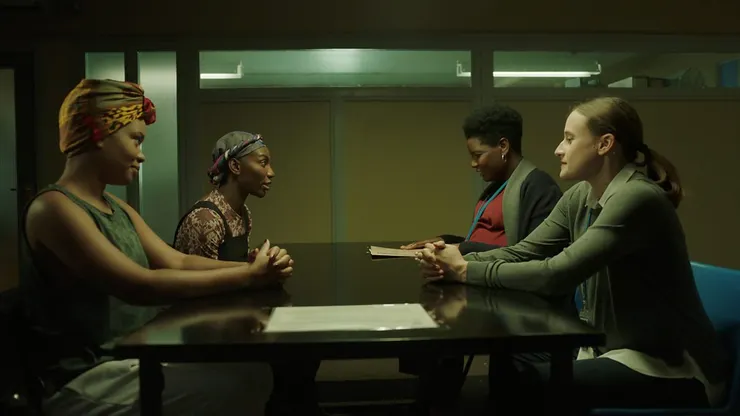
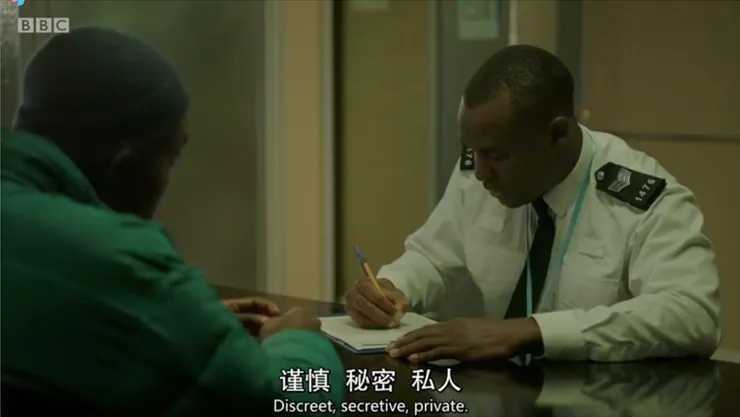
Arabella is questioned by two female police officers (up), and Kwame is questioned by a male police officer (down).
A similar dynamic appears in Wave Makers. In the second episode, Ya-jing experiences inappropriate physical contact from a male colleague. Initially, she decides not to file a formal complaint, instead resorting to physical retaliation and passive coping as a form of crisis management. Although Wen-fang offers her support, the company’s ultimate response remains largely contingent on the attitude of its male superior. In the ensuing meeting, the supervisor issues only a verbal reprimand to the perpetrator and requests a formal apology, without engaging in any structural reflection on the incident. While Ya-jing demonstrates personal initiative, the resolution remains individualistic and non-institutional, highlighting the absence of robust accountability mechanisms for addressing workplace sexual harassment in Taiwan.
In other words, despite differences in style and context, both works illustrate how contemporary culture, while urging survivors to speak out, simultaneously imposes boundaries on whose voices are granted legitimacy. The tension between survivors’ strategies for speaking and institutional modes of response emerges not only as a personal challenge for the characters but also as a reflection of deeper social structures and cultural norms.

Reference:
- Thompson, M. (2000) ‘Life after rape: A chance to speak?’, Sexual and Relationship Therapy, 15(4), pp. 325–343.
- Gill, R. (2007) ‘Postfeminist media culture: Elements of a sensibility’, European Journal of Cultural Studies, 10(2), pp. 147–166. London: SAGE Publications.
- Rottenberg, C., 2018. The rise of neoliberal feminism. Oxford: Oxford University Press.
- Kay, J.B., 2020. Gender, media and voice: Communicative injustice and public speech. New York City: Springer International Publishing.
- Crenshaw, K., & Phillips, A. (1998). Demarginalizing the Intersection of Race and Sex: A Black Feminist Critique of Antidiscrimination Doctrine, Feminist Theory, and Antiracist Politics. In Feminism And Politics. Oxford University Press.
- Ashworth, K. and Pedersen, C., 2023. ‘The feminine bravery construct: the crisis of neoliberal feminine bravery in the #MeToo moment’, Feminist Media Studies, 23(5), pp.2355–2373.
- Siegert, B., & Peters, J. D. (2012). Doors: On the materiality of the symbolic. Grey Room, (47), 6–23.