In the world of industrial material handling, Electric Overhead Traveling (EOT) cranes are among the most essential pieces of equipment. They are widely used in factories, steel plants, warehouses, shipyards, and construction sites to lift, transport, and position heavy loads with precision and safety. The design of an EOT crane, however, is a complex engineering task that must balance structural strength, operational efficiency, safety, and cost-effectiveness. One of the most transformative tools in modern crane engineering is Finite Element Analysis (FEA), a computational method that enables engineers to simulate and analyze structural behavior under various conditions. This article explores how FEA improves EOT crane design, highlighting its benefits, applications, and impact on crane performance and safety.
Understanding Finite Element Analysis in Crane Engineering
Finite Element Analysis is a numerical technique used to predict how a structure reacts to forces, vibrations, heat, and other physical effects. The core idea is to divide a complex structure into smaller, simpler elements—hence “finite elements”—which can be mathematically modeled. Each element interacts with its neighbors according to established physical laws, and the collective behavior is used to simulate the response of the entire structure.
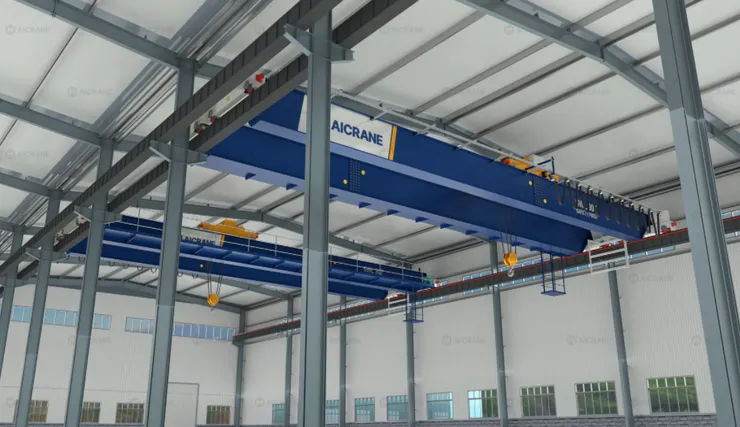
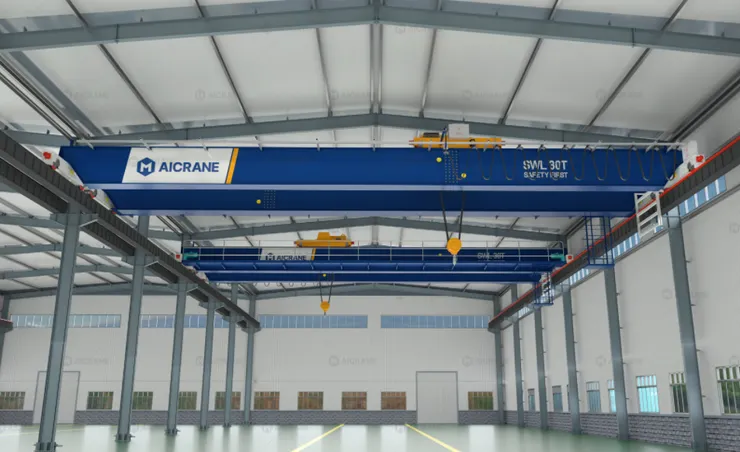
For EOT crane for sale, FEA allows engineers to create highly detailed models of the crane’s main components, including:
- Bridge girder and end trucks
- Hoist mechanism and trolley frames
- Support columns and rails
- Mechanical joints and connection points
By simulating various load scenarios, engineers can predict stress distribution, deflection, vibration modes, and fatigue life of the crane components before any physical prototype is built.
Enhancing Structural Strength and Safety
One of the primary advantages of using FEA in EOT crane design is improved structural strength and safety. Cranes operate under dynamic loads that can vary dramatically during lifting, acceleration, and braking. Traditional hand calculations may not capture localized stress concentrations or complex interactions between components. FEA, however, provides detailed insights into areas of high stress and potential failure.
For example, in an EOT overhead crane 50 ton lifting heavy steel coils, FEA can identify:
- Bending stresses in the bridge girder caused by uneven load distribution.
- Shear stresses in end trucks and wheel assemblies during acceleration.
- Fatigue hotspots in welded joints, which are prone to cracking over time.
By detecting these critical areas in the design phase, engineers can reinforce structures, optimize material thickness, or redesign connections to prevent failures, enhancing overall safety.
Optimizing Material Usage and Cost Efficiency
FEA also contributes to cost efficiency by enabling material optimization. Overdesigning crane components leads to excessive weight and increased manufacturing costs, while underdesigning can compromise safety. Using FEA, engineers can fine-tune the design by identifying which parts of the structure can be lighter without sacrificing strength.
For instance, through stress analysis of the crane bridge girder, engineers might find that certain regions experience minimal stress under all operating conditions. These areas can be redesigned with thinner plates or lighter profiles, reducing material costs and lowering the crane’s overall weight. A lighter crane can also reduce power consumption, as the motors require less energy to move the same loads, improving operational efficiency.
Improving Load Distribution and Dynamic Performance
EOT cranes are dynamic machines; they experience load variations due to acceleration, deceleration, trolley movement, and hoist operations. FEA allows engineers to simulate these dynamic conditions and evaluate how the crane responds.
- Dynamic stress analysis helps in understanding how the crane reacts to sudden starts and stops, ensuring that the frame and hoist components can withstand operational shocks.
- Vibration analysis identifies natural frequencies of the crane structure to prevent resonance, which could amplify oscillations and cause structural fatigue or operational instability.
- Deflection analysis ensures that under full load, the bridge girder and trolley maintain proper alignment, preventing misalignment of the hoist and minimizing wear on wheels and rails.
By integrating these analyses, engineers can enhance the crane’s operational smoothness, reduce maintenance needs, and extend its service life.
Facilitating Compliance with International Standards
EOT cranes are subject to strict international standards, such as ISO 4301, CMAA 70/74, and FEM guidelines, which define requirements for load ratings, deflections, safety factors, and operational performance. FEA allows designers to validate their designs against these standards digitally, ensuring compliance before physical testing.
- Load simulations verify that the crane can safely handle rated loads with the required safety margins.
- Structural checks ensure that deflection, bending, and torsional rigidity are within limits specified by standards.
- Fatigue life estimation confirms that the crane can operate reliably over its expected lifespan.
By using FEA to achieve standard compliance early, manufacturers can reduce the risk of costly redesigns, failed inspections, or operational downtime.
Supporting Innovation in EOT Crane Design
FEA is not only a tool for validation but also a platform for innovation. Engineers can explore new materials, configurations, and design concepts without the need to build multiple physical prototypes. For example:
- Lightweight high-strength steel alloys can be tested in simulations for bridge girders and end trucks, reducing weight while maintaining strength.
- Modular crane designs can be analyzed for stress and vibration behavior to ensure safety across different span lengths and load capacities.
- Advanced hoist systems and anti-sway mechanisms can be integrated into the model to optimize performance under variable operating conditions.
This accelerates the development of cranes with higher load capacities, longer spans, or improved energy efficiency, keeping manufacturers competitive in a demanding market.
Case Example: FEA in a 100-Ton Double Girder EOT Crane
Consider a 100-ton double girder EOT crane designed for a steel fabrication plant. Engineers use FEA to model the bridge girders, trolley, end trucks, and hoist under full load, including dynamic effects of starting, stopping, and lateral wind forces.
The FEA results reveal:
- Localized stress concentration at the welded joints connecting the bridge girder to the end trucks. Reinforcements are added to distribute stress.
- Excessive deflection in the middle of the bridge under maximum load. Adjusting the girder profile improves rigidity.
- Vibration mode alignment indicates potential resonance at a particular hoist speed, prompting a change in motor control parameters.
Through these optimizations, the crane is safer, more efficient, and requires fewer materials, while ensuring compliance with safety standards. Such improvements would be difficult, time-consuming, or impossible to identify through conventional design methods.
The Future of EOT Crane Design with FEA
As computational power and software capabilities continue to advance, FEA becomes even more integral to crane design. Future applications may include:
- Multi-physics simulations, integrating thermal, mechanical, and electromagnetic effects for electric motors and hoist systems.
- Digital twins, where FEA-based models mirror real cranes in operation, enabling predictive maintenance and performance optimization.
- AI-driven optimization, where algorithms automatically suggest design modifications based on FEA results to achieve optimal weight, strength, and efficiency.
These advancements will allow manufacturers to design smarter, safer, and more cost-effective cranes, addressing evolving industrial needs.
Conclusion
Finite Element Analysis has revolutionized EOT crane design, providing engineers with an unparalleled tool to simulate, analyze, and optimize complex structures. By improving structural strength, enhancing safety, optimizing material use, and facilitating compliance with international standards, FEA has become essential for modern crane engineering. Beyond validation, it enables innovation, allowing designers to explore new materials, configurations, and performance enhancements with confidence. As industries demand cranes with higher capacities, longer spans, and greater operational efficiency, FEA will continue to play a critical role in shaping the future of EOT crane design, ensuring that these machines remain reliable, safe, and efficient for decades to come.